The Water Law rewrite: 3.0 out of 5, better if fixed before the final vote
The clause that matters most: no fresh groundwater for mining from day one. Mining's fee rate could rise 2.6 to 5 times, and the protection zones would widen.
The clause that matters most in Mongolia’s new Water Law sits in one line: from 1 January 2027, no mine could use fresh groundwater for exploration, extraction or processing, and processing plants could use only treated, reused water (bill Art. 48.6). A companion bill says that ban applies from the first day, and that existing permits which break it must be changed or ended (procedure law Art. 7). About four-fifths of the water Mongolia uses is groundwater, and the bill’s own needs study says mining companies in the Gobi use it heavily.
We scored the whole bill on our Bill Watch scorecard: 3.0 out of 5, better if fixed before the final vote. It targets a real, measured problem with strong tools. It also has no phasing for the industry that pays most of the bill, two key terms whose reach is unclear, and a cost study with no figures.
Now: where the bill stands
The revised Law on Water was submitted by 13 members and entered on Parliament’s register on 24 October 2026. It has 8 chapters and 61 articles, and arrives with a package of companion bills: a procedure law, and amendments to the Law on Natural Resource Use Fees, the Land Law and others (bill papers, d.parliament.mn, 24 Oct 2026; companion bills in a register file dated 3 Nov 2026).
How a bill becomes law in Mongolia, and where this one is:
| Step | What happens | This bill |
|---|---|---|
| 1. Submitted | The bill and its papers go on the parliamentary register | ✔ 24 Oct 2026 |
| 2. Whether to take it up | The standing committee, then the plenary, vote on whether to discuss it at all | Under way: plenary debate on whether to take it up began 5 Nov 2026, and one party group took a five-working-day recess (ikon.mn, 5 Nov 2026). On 13 Nov a second party group took another five-working-day recess before the vote (ikon.mn, 13 Nov 2026) |
| 3. First reading | Article-by-article debate in committee; amendments proposed | Not yet |
| 4. Final vote | The plenary votes on the final text | Not yet |
| 5. In force | From the date the law sets | 1 Jan 2027 if passed as written (Art. 61.1) |
On 19 November the register still showed the bill at the “submitted” stage (d.parliament.mn register, read 19 Nov 2026). The bill has not passed, and we do not predict how Parliament will vote.
What the bill changes
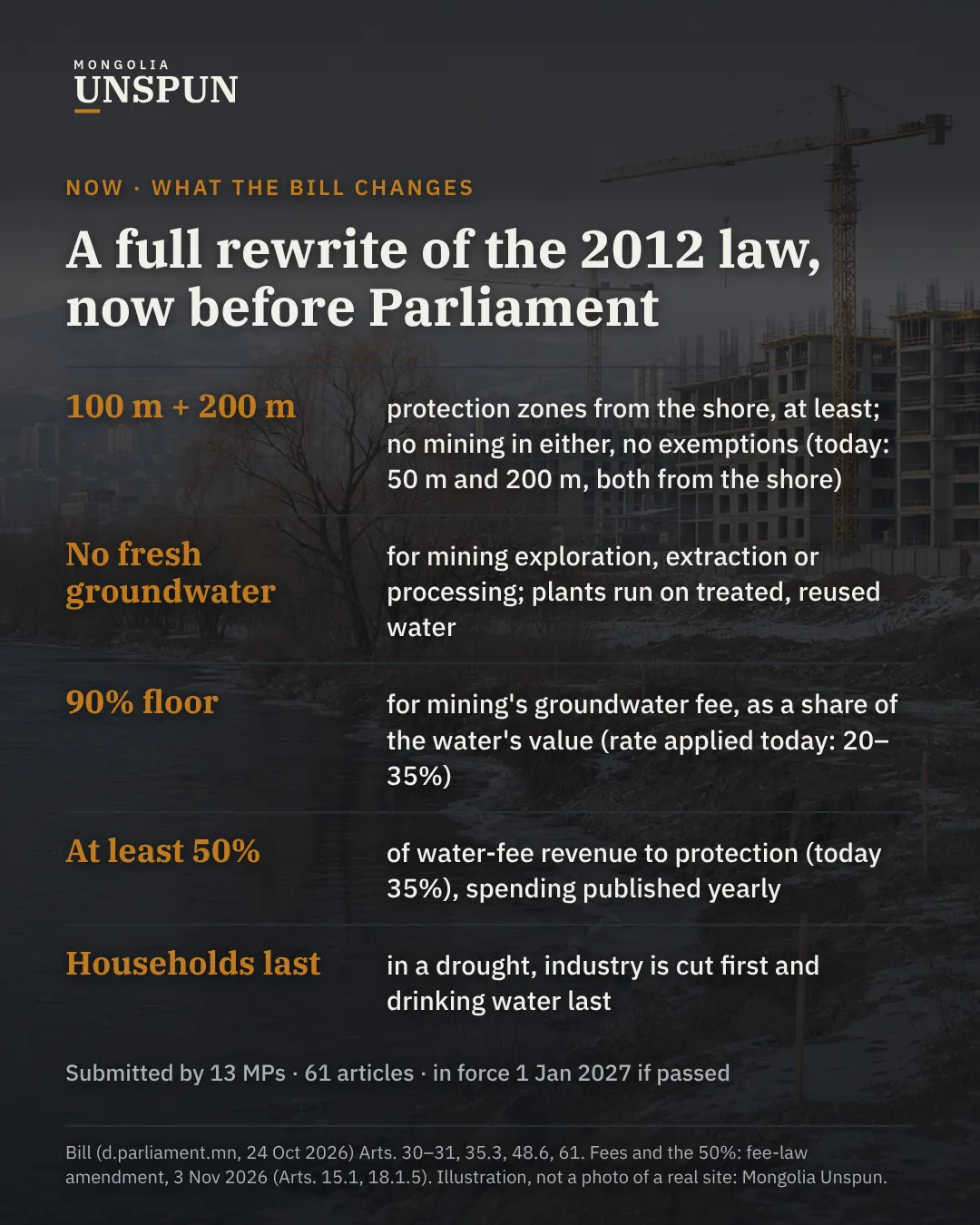
- No fresh groundwater for mining (Art. 48.6). Exploration, extraction and processing could not use it. Plants would run on water treated to a reuse standard (Art. 4.1.42).
- Wider protection zones (Arts. 30–31). A special zone of at least 100 m from the shore, and an ordinary zone of at least 200 m beyond it. Mineral exploration and mining are banned in both. Today the special zone is at least 50 m and the ordinary zone at least 200 m, both measured from the shore (2012 Law on Water, Arts. 22.2–22.3). The bill would move the outer edge from 200 m to at least 300 m.
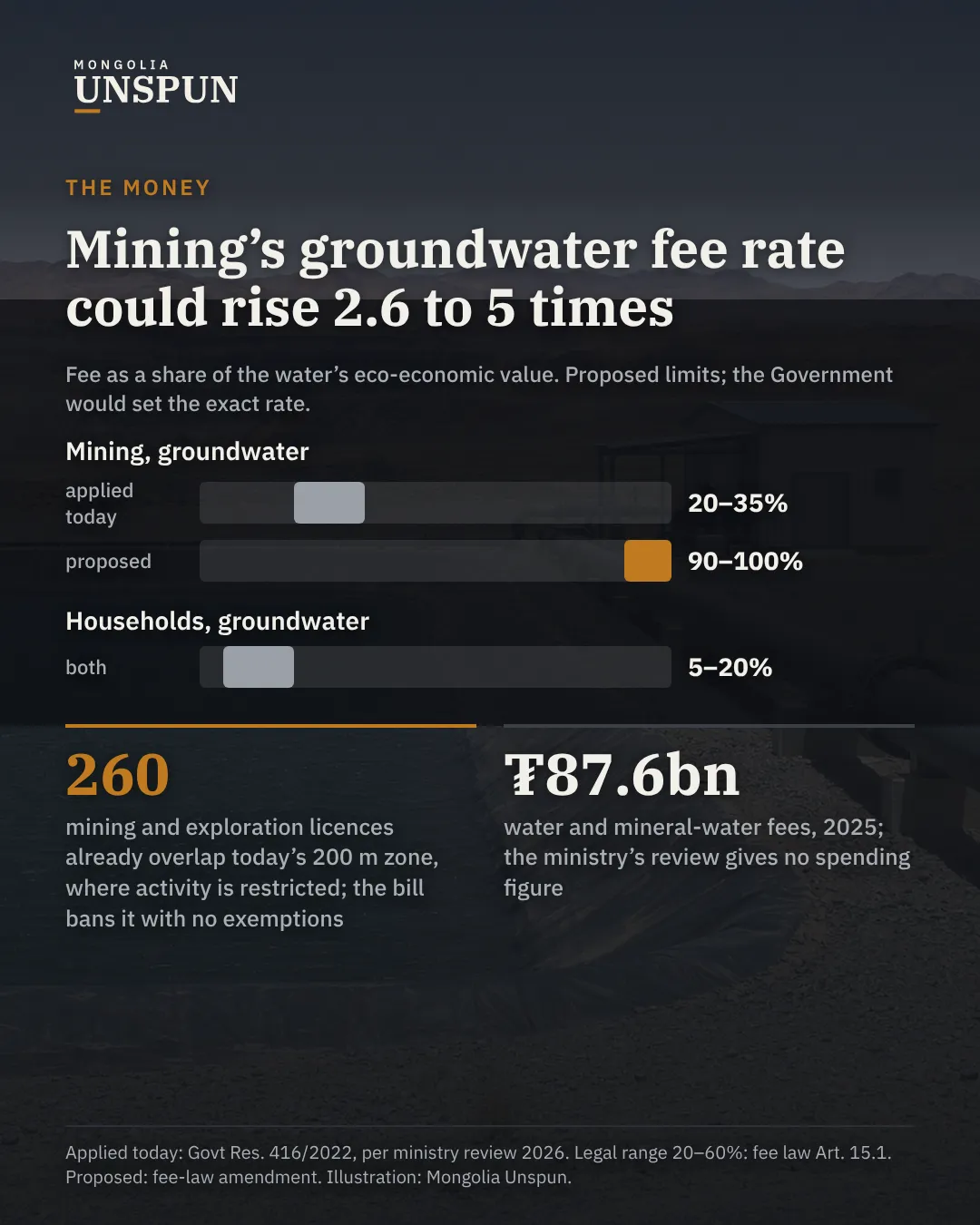
- Much higher fees for mining (fee-law amendment, new Art. 15.1). Fees are set as a share of the water’s eco-economic value, within limits; the Government sets the exact rate each year (new Art. 15.3).
- More money for protection. The share of water-fee revenue that must go to protecting water rises from 35% to 50% (Law on Natural Resource Use Fees Art. 18.1.5, amended), and the spending and its results must be published every year (new Art. 18.3).
- Drinking water last to be cut in a drought (Art. 35.3). Use is restricted in this order: industry, services, farming, livestock, and drinking and household use last.
- No foreign ownership or possession of water resources or water-fund land (Art. 6.4).
The fee limits in the bill
Share of the water’s eco-economic value, per cubic metre (fee-law amendment, new Art. 15.1):
| Use | Surface water | Groundwater |
|---|---|---|
| Mining: extraction and processing | 80–100% | 90–100% |
| Mining: copper concentrate and fluorspar processing | 80–100% | 90–100% |
| Mining: dewatering (pumping water out of pits) | 100% | 100% |
| Mining: exploration drilling | 50–100% | 60–100% |
| Heavy industry, construction, roads | 30–100% | 60–100% |
| Energy | 10–15% | 15–30% |
| Crop farming | 1–20% | 10–40% |
| Drinking and household use | 1–10% | 5–20% |
For mining groundwater used in extraction and processing, the current Law on Natural Resource Use Fees allows 20–60% (Art. 15.1), and Government Resolution 416 of 2022 applies 20–35% (Ministry of Environment and Climate Change, review of the Law on Water’s implementation, 2026). A floor of 90% is 2.6 times today’s top applied rate (90 against 35). At 100%, the rise from the bottom applied rate is fivefold (100 against 20). These are our calculations, and they compare percentages only: the water’s valuation itself is due to be revised, and today’s rates apply until new ones are set (procedure law Arts. 14–15). The amendment also bills a mine’s yearly water as the larger of the mining sector’s water norm and the amount under item 7 of new Art. 15.1. The clause is loosely drafted, and we read it as a floor set by the norm (new Art. 15.4).
Then: why it matters
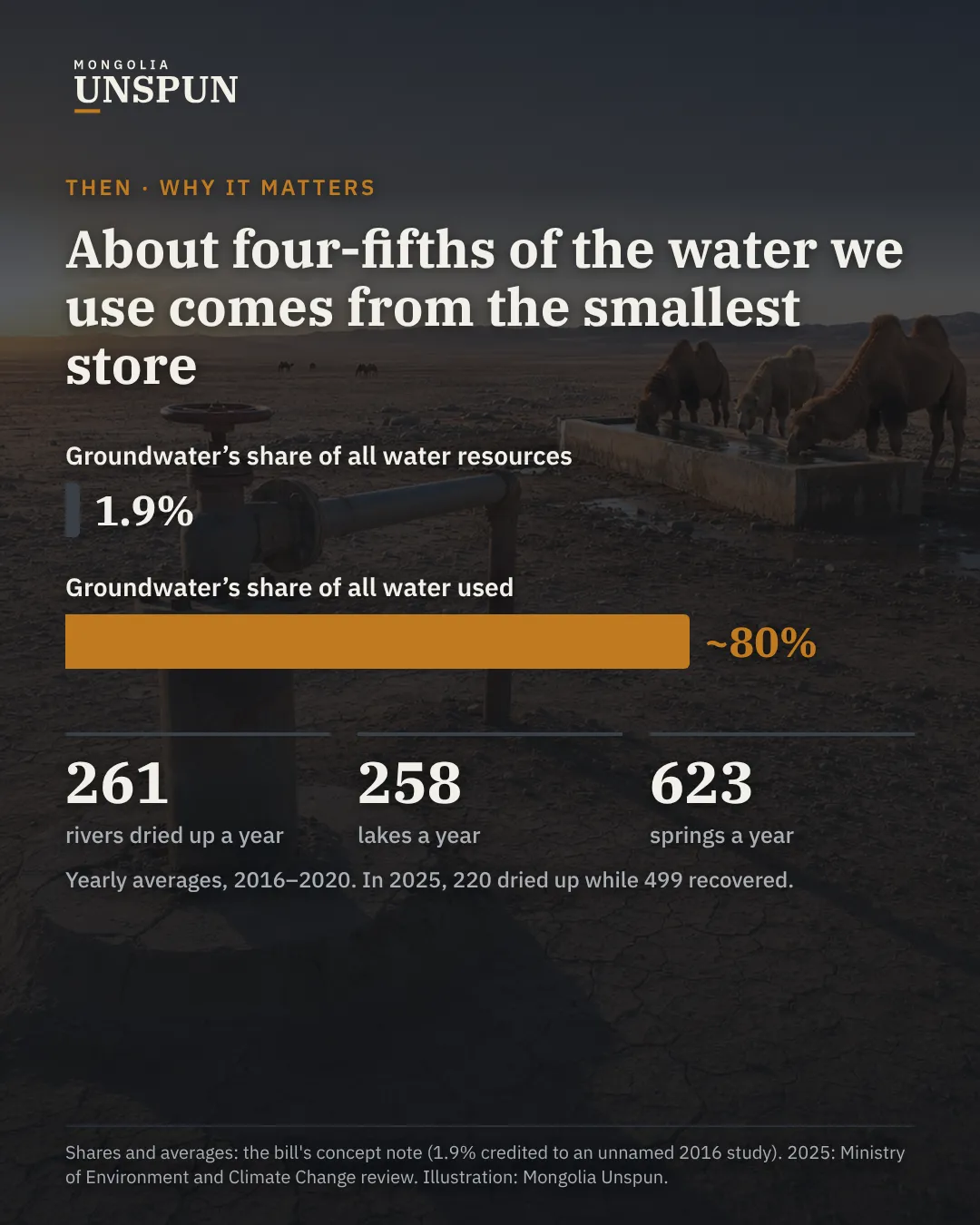
About four-fifths of the water Mongolia uses comes from groundwater, which is only about 1.9% of its water resources. These shares come from the bill’s concept note (the 80% also appears in its needs study). The 1.9% is credited to an unnamed 2016 study, and the 80% has no source. We treat them as single-source until the Ministry of Environment and Climate Change or the National Statistics Office publishes the underlying table.
The concept note gives yearly averages for 2016–2020: 261 rivers, 258 lakes and 623 springs dried up each year. The picture is not one-way. The Ministry of Environment and Climate Change’s review of the 2012 law reports that in 2025, 220 water bodies dried up while 499 recovered.
A 2025 amendment opened the special protection zones to public infrastructure such as roads and rail (ikon.mn, 1 Oct 2026). That is one reason we score urgency high.
Who is affected, and how much
| Who | What changes | How much |
|---|---|---|
| Mines and exploration licences inside the zones | Activity banned, no exemptions | About 260 licences (222 mining, 38 exploration) already overlap today’s 200 m ordinary zone, where the 2009 law already restricts their activity (Ministry of Environment and Climate Change review, 2026). The bill papers give no figure for output or jobs affected. |
| Mines and plants using fresh groundwater | Must switch to treated, reused water from day one | Not costed in the bill papers. |
| Mining fee payers | Groundwater fee floor of 90% of the water’s value | 2.6 to 5 times today’s applied rate (our calculation). No tögrög total in the bill papers. |
| Protection budgets | Half of fee revenue ring-fenced, spending published | Water and mineral-water use fees brought ₮87.6 billion into local budgets in 2025; the ministry’s review gives no figure for protection spending. |
| Households and herders | First call on water in a drought; wider zones around their sources | Household fee limits stay at 1–10% (surface) and 5–20% (groundwater). |
| Foreign-invested companies | Same rules as Mongolian firms, plus the ownership clause | Reach unclear: the bill does not say how Art. 6.4 applies to Mongolian companies with foreign shareholders. |
The bill’s papers give no figures for any of these effects. That is why evidence scores 2.
The scorecard
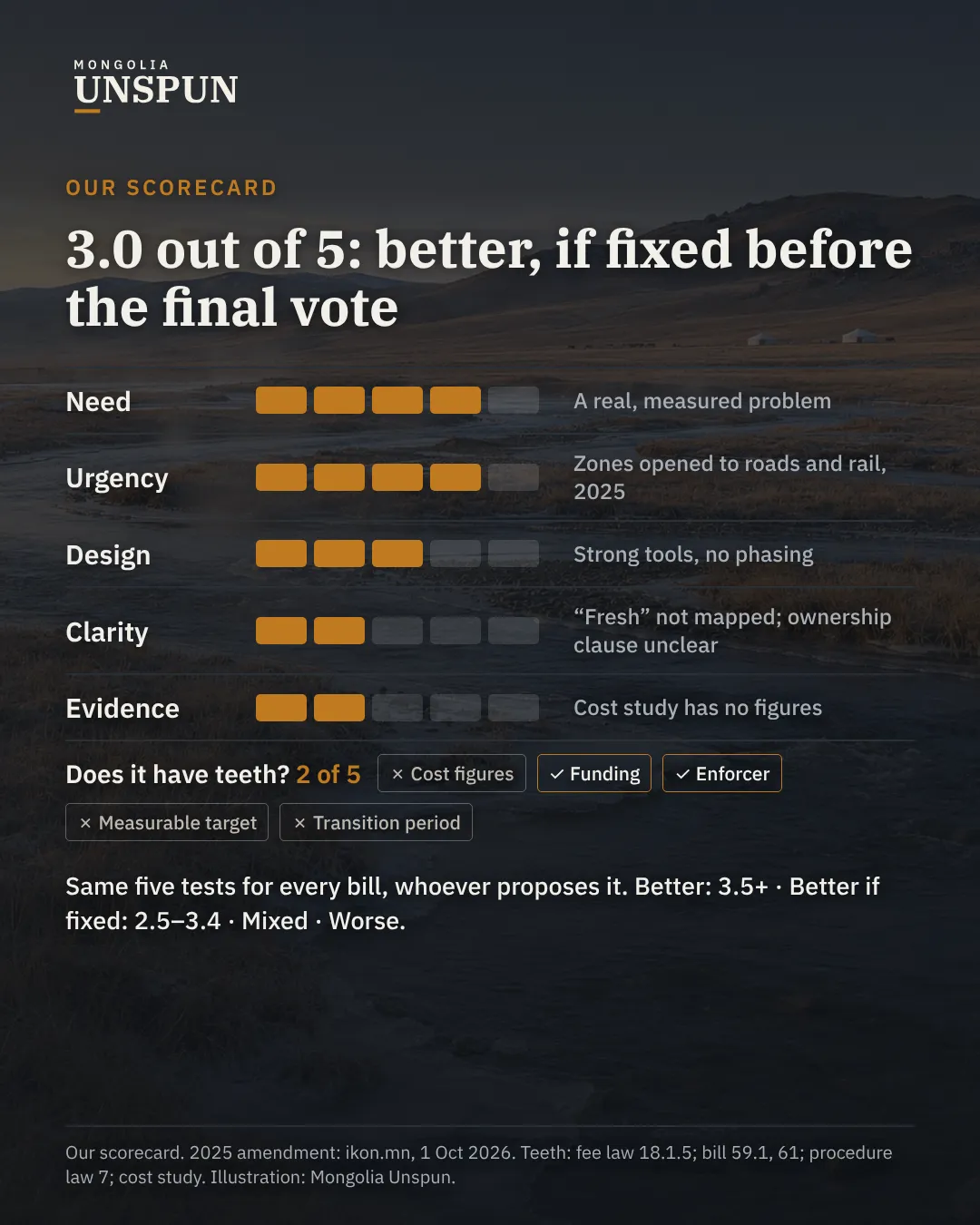
Same five tests for every bill, whoever proposes it. Each test is scored 1 to 5, and the overall score is the plain average.
| Test | Score | Why |
|---|---|---|
| Need | 4 | A real, measured problem: groundwater carries most of the load. |
| Urgency | 4 | The zones were opened to roads and rail in 2025; harm grows while they stay open. |
| Design | 3 | Strong tools that target the cause, but no phasing for mines that use fresh groundwater or sit inside the zones. |
| Clarity and enforceability | 2 | “Fresh” water is defined (Art. 4.1.53: no more than 1,000 mg of dissolved minerals per litre and fit to drink), but there is no public map of which aquifers meet it, so no one can yet tell which wells the ban covers; the reach of the ownership clause is unclear. |
| Evidence and costing | 2 | The cost study attached to the bill contains no figures. |
| Overall | 3.0 | Better if fixed |
Verdict bands: Better: 3.5 and above, with no major risk · Better if fixed: 2.5 to 3.4 · below that, Mixed or Worse, judged on the tests and the risks · Can’t judge yet: key text is missing.
Does it have teeth? 2 of 5
| Fact checked in the bill text | Present? |
|---|---|
| A cost estimate with figures | ✖ No |
| A named funding source | ✔ Yes: 50% of water-fee revenue to protection (fee law Art. 18.1.5, amended) |
| A named body that enforces it | ✔ Yes: liability under the Law on Infringements and the Criminal Code (Art. 59.1), with the river-basin administrations (Art. 17) |
| A measurable target | ✖ No |
| A transition period | ✖ Not for the core change. Existing permits run to their term (procedure law Art. 1) and old zone boundaries hold until redrawn (Art. 9; maps due by 31 Dec 2027, Art. 10), but the groundwater ban applies from day one (Art. 7) |
What other countries did
Chile, 2022. Chile rewrote its water code in Law 21,435, published on 6 April 2022. It put human consumption, sanitation and subsistence first, made new water rights 30-year grants, renewed automatically unless unused or harmful, instead of indefinite, and widened the ban on rights in glaciers and protected areas. It also gave holders of old rights time: 18 months to register, and five years (ten for non-consumptive rights) before rights that go unused can be lost (Carey, Apr 2022). Separately, Chile’s copper miners have been moving to seawater for over a decade: 40.7% of the sector’s water in 2024, projected at 67.6% by 2034 (Cochilco, reported by Reuters via Mining.com, 18 Mar 2026). Mongolia has no coast. The lesson is about pace: even with an obvious alternative source, the switch took years.
Mongolia, 2009. Mongolia has tried a broad ban before. The 2009 law known as the “Law with the Long Name” banned mineral exploration and mining at river headwaters, in protected zones around water and in forests, and required the Government to compensate cancelled licence holders (law text, Arts. 4.1, 4.2 and 4.6, archived by Rivers without Boundaries). Strategic deposits were exempt. Counts of affected licences differ by source, from about 1,300 to about 1,800 (Oxford Business Group, 6 Mar 2012; ministry figures quoted by Rivers without Boundaries, 21 Feb 2015). In January 2015 the Ministry of Mining put the initial compensation figure at ₮2,223.93 billion, calculated under the procedure set by Government Resolution 299 of 2010 (ministry press release, as quoted by Rivers without Boundaries). Payouts were delayed, and enforcement was contested for years (Rivers without Boundaries, 21 Feb 2015). The lesson: a ban that does not say who pays, and how much, is hard to hold. The 2026 bill papers we read set no compensation figure.
Buffer zones elsewhere: we did not find a like-for-like comparison of mining buffer widths this pass. Evidence is thin.
Next: three scenarios
These are scenarios, not forecasts. We do not predict how Parliament will vote. Each describes what would follow from one version of the law.
Base: if it passes with minor amendments and no phasing, in force on 1 January 2027. The fee rises once the Government sets the rate inside the new limits. Mines using fresh groundwater must stop or switch with little time to adjust. Licences inside the wider zones face the same once the new boundaries are drawn (due by 31 December 2027, procedure law Arts. 9–10). Signals: the Government resolution setting the rate; ministry notices on overlapping licences; NSO monthly mining output.
Better: if it passes with phasing and clear definitions. A 3–5 year transition, a public map of which aquifers count as fresh, and at least half of fee revenue spent on protection and published. The 2025 balance (220 dried up, 499 recovered) becomes a yearly scorecard. Signals: a transition article in the final text; the first published spending report.
Worse: if it passes exactly as written, or stalls with no change. As written, plants using fresh groundwater face a sudden stop in January 2027, and operations in the wider zones once the new boundaries are drawn (by the end of 2027), while exports already face delays at the China border (AP via Fortune, 29 Oct 2026). Stalled, the 2016–2020 pattern of losses continues with no new protection. Signals: licence suspensions; mining export volumes from Customs; another session’s delay.
We score scenarios like these in our public track record at mongolia-unspun.mn/outlook/track-record.
What would fix it
1. Phase the groundwater ban over 3–5 years, with a public map of which aquifers meet the bill’s definition of fresh water.
- Rough cost: not costed in the bill papers. The register is survey and mapping work; we found no published estimate.
- Who could finance it: the fee revenue the bill ring-fences for protection (₮87.6 billion in 2025; under the bill at least half would go to protection), with mines paying for their own treatment and reuse systems.
- How long: 3–5 years for operators; the register first.
- Other countries: Chile gave existing right holders 18 months to five years.
2. Say who pays for licences closed by the zones, and how much.
- Rough cost: unknown until the licences are mapped; the 2009 experience shows it can be large.
- Who: the Government, in the cost study, before the final vote.
- How long: weeks, using the licence register the ministry already holds.
3. Pin down the ownership clause. State exactly how Art. 6.4 applies to Mongolian companies with foreign shareholders.
- Rough cost: drafting only.
- Who: the working group and the standing committee.
- How long: before the final vote.
4. Put numbers in the cost study: who pays how much, and what the zones would stop.
- Rough cost: small; the ministry holds the fee records and the licence register.
- How long: weeks.
5. Add supply for Ulaanbaatar. In the medium-demand scenario of a 2016 study for the 2030 Water Resources Group, 28% of the capital’s water demand would go unmet by 2030 (filed in World Bank project P181147 documents, 2024). The estimate is ten years old.
- Rough cost: we did not find a sourced total this pass; evidence is thin.
- Who could finance it: the state budget with development-bank lending, as in the World Bank project.
The case against
Sudden bans and fee rises land on the sector that earns most of Mongolia’s export income, at a time when exports are already strained at the border. The strongest version of this argument says the fee rise alone would do most of the work, and that a zone ban with no exemptions and no compensation figure risks repeating 2009: licences legally issued, then cancelled, then fought over for years. The bill’s own cost study recommends phasing and transition periods, and fix 1 answers part of this argument. It does not answer the cost to licence holders inside the zones, which no one has yet put a number on.
📎 Sources
- Revised Law on Water draft and bill papers (concept note, cost study, assessments), d.parliament.mn, submitted 24 Oct 2026: Arts. 4.1.42, 6.4, 30–31, 35.3, 48.6, 59.1, 61.1.
- Companion bills, 3 Nov 2026: procedure law (Arts. 1, 7, 9); amendment to the Law on Natural Resource Use Fees (Arts. 15.1–15.4, 18.1.5, 18.3).
- Ministry of Environment and Climate Change, review of the implementation of the 2012 Law on Water, 2026.
- Government Resolution 416 of 2022.
- ikon.mn, 5 Nov 2026.
- ikon.mn, 1 Oct 2026 (2025 amendment on the protection zones); ikon.mn, 13 Nov 2026.
- 2030 Water Resources Group, hydro-economic analysis for Ulaanbaatar, Aug 2016 (in World Bank project P181147 documents, 2024).
- AP via Fortune, 29 Oct 2026.
- Carey, Apr 2022; Reuters via Mining.com, 18 Mar 2026.
- 2009 law text and 2015 account, Rivers without Boundaries; Oxford Business Group, 6 Mar 2012.
The pictures behind our charts are illustrations, not photos of real sites.
By Munkh-Erdene B. (Sam), Mongolia Unspun
Sources
- State Great Khural register: revised Law on Water draft and bill papers (registered 24 Oct 2026)
- Companion bills (register file dated 3 Nov 2026): procedure law; amendment to the Law on Natural Resource Use Fees
- Law on Water (2012), Arts. 22.2–22.3
- Ministry of Environment and Climate Change: review of the implementation of the Law on Water (2026), filed with the bill papers
- Government Resolution No. 416 (2022), water-fee rates (as reported in the ministry review)
- ikon.mn, 5 Nov 2026: debate on the revised Law on Water begins
- ikon.mn, 13 Nov 2026: second party-group recess
- ikon.mn, 1 Oct 2026: 2025 amendment on the protection zones
- AP via Fortune, 29 Oct 2026: border restrictions cut Mongolia's copper exports
- Carey, Apr 2022: Chile's Water Code reform (Law 21,435) enacted
- Reuters via Mining.com, 18 Mar 2026: Cochilco seawater projection
- Rivers without Boundaries: text of the 2009 'Law with the Long Name'
- Rivers without Boundaries, 21 Feb 2015: ministry figures on the 2009 law
- Oxford Business Group, 6 Mar 2012: licensing and the 2009 law
- 2030 Water Resources Group, hydro-economic analysis for Ulaanbaatar (Aug 2016), in World Bank project P181147 documents (2024)
- Mongolia Unspun Bill Watch scorecard
Corrections · Spotted a mistake? See how we correct it.
One study every Tuesday.
The data on Mongolia's economy, what it means and what would fix it. Free. In English.
To subscribe, please turn on JavaScript.
We'll email you once to confirm. No confirmation, no letter.
Suggest a topic Tell us what you want explained, measured or checked. We read every suggestion, and we reply to everyone who leaves an email.